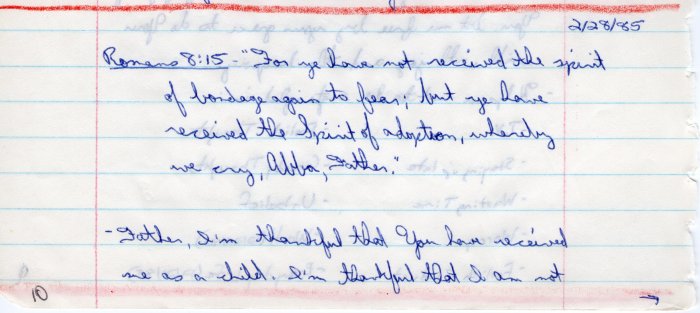
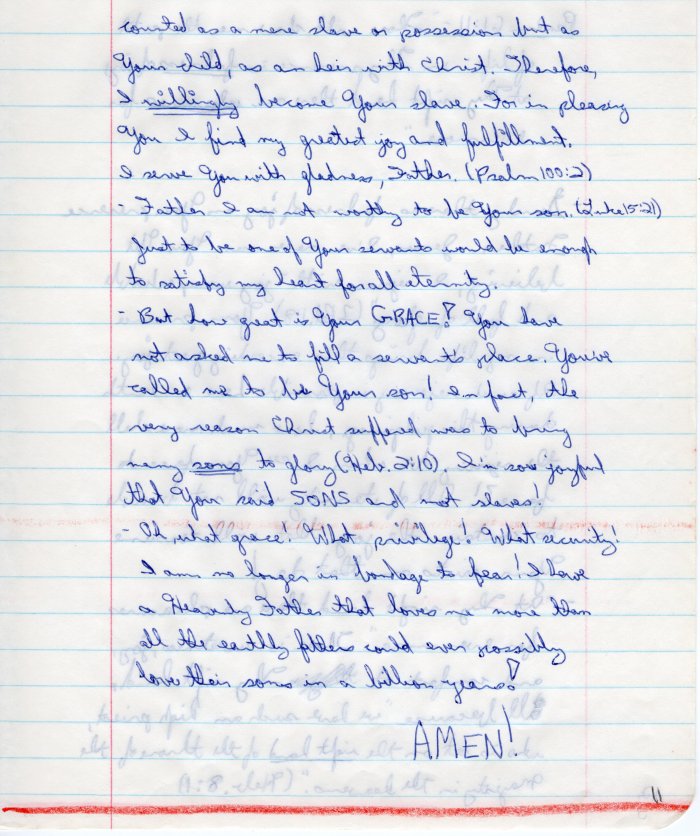
This was written in February of 1985 in a notebook that turned into a full fledged journal later that year. (I’m on notebook #48 in my private journal now.) My, things were so different then! So much has changed in the world over 31 years! Cell phones and personal computers weren’t things back then. I myself have changed in so many ways and in so many directions. I’ve grown. I’ve fallen. I’ve turned aside. I’ve turned back. One thing I can say is that I whole-heartedly believe all the words I wrote on February 28, 1985. God’s grace is the only reason why I can say that.
With thankfulness for such grace, I am posting this reflection/prayer on this Father’s Day in 2026.
Transcription
Romans 8:15 – “For ye have not received the spirit of bondage again to fear; but ye have received the Spirit of adoption, whereby we cry, Abba, Father.”
“Father, I’m thankful that You have received me as a child. I’m thankful that I am not counted as a mere slave or possession but as Your child, as an heir with Christ. Therefore, I willingly become Your slave. For in pleasing You I find my greatest joy and fulfillment. I serve you with gladness, Father. (Psalm 100:2 – “Serve the Lord with gladness: come before His presence with singing.”)
“Father, I am not worthy to be Your son. (Luke 15:21) Just to be one of Your servants would be enough to satisfy my heart for all eternity.
“But how great is Your GRACE! You have not asked me to fill a servant’s place. You’ve called me to be Your son! In fact, the very reason Christ suffered was to bring many sons to glory. (Hebrews 2:10) I’m so joyful that You said SONS and not slaves!
“Oh, what grace! What privilege! What security! I am no longer in bondage to fear! I have a Heavenly Father that loves me more than all the earthly fathers could ever possibly love their sons in a billion years!”
25 years ago, and for many years along the way, I was developing this website in Notepad. We were hardcore in those days. Dream Weaver? No thanks! I like making HTML errors. Now we have this fancy WordPress machine to crank out blog posts.
But the funny thing is that I post way less than I did back in the day. I guess it’s that way with most things. You start out hot and really into it. Then it fades over time. However, I have been thinking about writing more regularly again. At least for my own sake. Now that I am 25 years older than I was in 2000, dementia is more a possibility than a joke. I should write more to exercise my brain. And to keep track of things in case I forget them. “Bloggingsam… The Golden Years”
I don’t have any readers though. “Build it and they will come.” Yeah, maybe. People used to sign up to be on my email list years ago. I bet I could dig up copies of those old email notifications I used to send out. Hold on. I gotta go search my old Yahoo email account. Good thing I never delete emails.
You know what? I found some emails from those old days. I don’t want to share any of them. I was kind of obnoxious and vain back then. I found an email in which someone asked to be removed from my email list because they found me to be “unreliable” and “tasteless.” They never knew when they got an email from me whether my content would be worth their time. So, I replied with an obnoxious email. That’s embarrassing.
So let’s just move on. Maybe I’ll do more posts. Maybe I won’t. Maybe my website and I will simply fade out into the greyness of dementia and not worry about it.
If you are interested, here is my first post from December 30, 2000: Snow and Chinese Food. Beware of tastelessness and obnoxiousness along the way if you decide to read more posts in the big pile of this website. There may be a few things worth your time. Then again, one man’s tastelessness is another man’s time worthiness. The eye of the beholder and all that.
To anyone who ever reads this post, Thanks for noticing me.
Here’s another “coincidence” in my daily reading. This time between Proverbs 4:18 from my daily reading of Proverbs: “But the path of the just is as the shining light, that shineth more and more unto the perfect day,” and a section of John Owen on that same verse which I “happened” to read the same day.
I am almost finished reading Owen’s “Meditations and Discourses Concerning the Glory of Christ,” which followed his longer “Meditations and Discourses on the Glory of Christ, in His Person, Office, and Grace: with the Differences Between Faith and Sight; Applied unto the Use of Them That Believe.”
Sidebar: Why don’t authors use such magnificently lengthy descriptive titles anymore?
Let me quote Owen. This is from Owen’s Works, volume 2, pages 438 – 440, Banner of Truth edition.
That this spiritual life is in its nature and constitution such as will abide, thrive, and grow to the end, is three ways testified unto in the Scripture.
In that it is compared unto things of the most infallible increase and progress; for besides that its growth is frequently likened unto that of plants and trees well-watered, and in a fruitful soil, which fail not to spring, unless it be from some external violence; it is likewise compared unto such things as whose progress is absolutely infallible, Prov. 4:18, “The path of the just is as the shining light, that shineth more and more unto the perfect day.” The path of the just is his covenant-walk before God, as it is frequently called in the Scripture, Ps. 119:35, 105; Isa. 26:7; Ps. 23:3; Matt. 3:3; Heb. 12:13; and it compriseth the principle, profession, and fruits of it. This, saith the wise man, is as the shining light; that is, the morning light. And wherein is it so? Why, as that goeth on by degrees, and shineth more and more unto the high noon (though it may be interrupted sometimes by clouds and storms); so is this path of the just, – it goes on and increaseth unto the high noon, the perfect day of glory. It is in its nature so to do, though it may sometimes meet with obstructions, as we shall see afterward; and so doth the morning light also.
There is no visible difference, as unto light, between the light of the morning and the light of the evening; yea, this latter sometimes, from gleams of the setting sun, seems to be more glorious than the other. But herein they differ: the first goes on gradually unto more light, until it comes to perfection; the other gradually gives place unto darkness, until it comes to be midnight. So is it as unto the light of the just and of the hypocrite, and so is it as unto their paths. At first setting out they may seem alike and equal; yea, convictions and spiritual gifts acted with corrupt ends in some hypocrites, may for a time give a greater lustre of profession than the grace of others sincerely converted unto God may attain unto. But herein they discover their different natures: the one increaseth and goeth on constantly, though it may be sometimes but faintly; the other decays, grows dim, gives place to darkness and crooked walking.
This, then, is the nature of the path of the just; and where it is otherwise with us in our walk before God, we can have no evidence that we are in that path, or that we have a living, growing principle of spiritual life in us. And it is fit that professors of all sorts should be minded of these things; for we may see not a few of them under visible decays, without any sincere endeavors after a recovery, who yet please themselves that the root of the matter is in them. It is so, if love of the world, conformity unto it, negligence in holy duties, and coldness in spiritual love, be an evidence of such decays. But let none deceive their own souls; wherever there is a saving principle of grace, it will be thriving and growing unto the end. And if it fall under obstructions, and thereby into decays for a season, it will give no rest or quietness unto the soul wherein it is, but will labor continually for a recovery. Peace in a spiritually-decaying condition, is a soul-ruining security; better be under terror on the account of surprisal into some sin, than be in peace under evident decays of spiritual life.
And, by the way, this comparing of the path of the just unto the morning light minds me of what I have seen more than once. That light hath sometimes cheerfully appeared unto the world, when, after a little season, by reason of clouds, tempests, and storms, it hath given place again to darkness, like that of the night; but it hath not so been lost and buried like the evening light. After a while it hath recovered itself unto a greater lustre than before, manifesting that it increased in itself whilst it was eclipsed as to us. So hath it been with not a few at their first conversion unto God: great darkness and trouble have, by the efficacy of temptation and injections of Satan, possessed their minds; but the grace which they have received, being as the morning light, hath after a while disentangled itself, and given evidence that it was so far from being extinguished, as that it grew and thrived under all those clouds and darkness; for the light of the just doth in the issue always increase by temptations, as that of the hypocrite is constantly impaired by them.
Again, as it is as the morning light, than which nothing hath a more assured progress; so it is called by our Savior “living water,” John 4:10, yea, “a well of water, springing up into everlasting life,” verse 14. It is an indeficient spring, – not a pool or pond, though never so large, which may be dried up. Many such pools of light, gifts, and profession, have we seen utterly dried up, when they have come into age, or been insnared by the temptations of the world. And we may see others every day under dangerous decays; their countenances are changed, and they have lost that oil which makes the face of a believer to shine, – namely, the oil of love, meekness, self-denial, and spirituality of converse; and instead thereof, there is spread upon them the fulsome ointment of pride, self-love earthly-mindedness, which increaseth on them more and more. But where this principle of spiritual life is, it is as the morning light, as an indeficient spring that never fails, nor can do so, until it issue in eternal life. And sundry other ways there are whereby the same truth is asserted in the Scripture.
Why did I quote this lengthy passage?
Because of the charming old word “indeficient,” of course! And the spelling of “lustre!” (Lustré? “Must be Italian!”) (In case your perception of the preceding reference is lackluster, see here: https://youtu.be/4ewXbqRUdjU?si=slIhPazGOPYSJZ_E)
I quoted it at length because it gives me hope. And that is because Owen recognizes that a Christian’s progress in sanctification is not always steady and bright. “It may be interrupted sometimes by clouds and storms.” When a true believer backslides, falls into sin, is fainthearted and gives up – “falls into decay,” as Owen terms it, there is yet a “principle of saving grace” that “will give no rest or quietness unto the soul wherein it is, but will labor continually for a recovery.”
Owen writes about these “decays” as being “for a season.” For me, that season lasted for such a length that it makes me often question whether I had such a principle of grace within me to begin with, or whether grace truly entered my heart just a few years ago. Sometimes, due to continued frequent fallings and failings, I question if God’s grace is truly within me even now. So it’s almost a moot point. Was I truly saved at age 17 while still in high school? And then did I fall away for “a season,” that season lasting 22 years? Did the clouds then start to clear to allow the light of the grace within me to shine again? You know what? This is what matters: “TODAY if you hear His voice, harden not your heart.” (Heb. 3:15) “And the Spirit and the bride say, Come. And let him that heareth say, Come. And let him that is athirst come. And whosoever will, let him take the water of life freely.” (Rev. 22:17)
This morning, in my daily Bible reading, I read Luke 9. In this chapter is the account of the Transfiguration.
Luke 9:28 – 36
28. And it came to pass about an eight days after these sayings, He took Peter and John and James, and went up into a mountain to pray.
29. And as He prayed, the fashion of His countenance was altered, and His raiment was white and glistering.
30. And, behold, there talked with Him two men, which were Moses and Elias:
31. Who appeared in glory, and spake of His decease which He should accomplish at Jerusalem.
32. But Peter and they that were with Him were heavy with sleep: and when they were awake, they saw His glory, and the two men that stood with Him.
33. And it came to pass, as they departed from Him, Peter said unto Jesus, Master, it is good for us to be here: and let us make three tabernacles; one for Thee, and one for Moses, and one for Elias: not knowing what he said.
34. While he thus spake, there came a cloud, and overshadowed them: and they feared as they entered into the cloud.
35. And there came a voice out of the cloud, saying, This is My beloved Son: hear Him.
36. And when the voice was past, Jesus was found alone. And they kept it close, and told no man in those days any of those things which they had seen.
Then, while reading Haldane on Romans 8:18, he referred to the Transfiguration in the following way.
Romans 8:18 – “For I reckon that the sufferings of this present time are not worthy to be compared with the glory which shall be revealed in us.
Haldane:
The Apostle had been reminding those to whom he wrote, that their sufferings with Christ is the way appointed by God to bring them to glory. Here he encourages them to endure affliction, because there is no comparison between their present sufferings and their future glory. In order to encourage the Israelites to sustain the difficulties that presented themselves in their entry into Canaan, God sent them of the fruits of the land while they were still in the desert. Our blessed Lord, too, permitted some of His disciples to witness His transfiguration, when His face did shine as the sun, and His raiment was white as light. This was calculated to inspire them with an ardent desire to behold that heavenly glory, of which, on that occasion, they had a transient glimpse, and to render them more patient in sustaining the troubles they were about to encounter. In the same manner God acts towards His people when they suffer in this world. He sends them of the fruits of the heavenly Canaan, and allowing them to enjoy a measure of that peace which passeth all understanding, He favors them with some foretastes of the glory to be revealed.
Sometimes I have thought, What was the purpose of the Transfiguration? It used to seem like a disconnected event to me. Sure, it gave further proof to the three apostles that was the Son of God. They heard Him conversing about His upcoming death at Jerusalem. It gave them much to contemplate and proclaim later. But it seemed disjointed to me. Over the years I have come to think otherwise. Haldane’s reference to it as an inspiration to be kept in mind during the trials make it more integral to the Christian experience. Praise God.
This morning I read my daily chapter of Proverbs. Since it is the third day of the month, I read chapter 3.
Then I went to the New Testament to read the next chapter in my daily reading of the Epistles, which was James 4.
In James 4:6 there is a quotation from Proverbs 3:34.
James 4:6 – “But He giveth more grace. Wherefore He saith, God resisteth the proud, but giveth grace unto the humble.”
Proverbs 3:34 – “Surely He scorneth the scorners: but He giveth grace unto the lowly.”
Before reading this I was struggling with unrighteous thoughts. I was tempted to avoid reading my Bible. Instead, by God’s grace, I decided to read despite my thoughts and emotions. So I read Proverbs 3 out loud. That helped me to pray, to consider trusting the Lord with all my heart and leaning not to my own understanding, to acknowledge Him in all my ways so that He would make my paths straight, to even pray for help on a work related issue where my path is currently not straight and clear.
Then I flipped over to James. The first half of the chapter spoke directly to me in my exact current frame of mind as far as the unrighteous thoughts go. James cuts right to the heart.
James 4
1. From whence come wars and fightings among you? Come they not hence, even of your lusts that war in your members?
2. Ye lust, and have not: ye kill, and desire to have, and cannot obtain: ye fight and war, yet ye have not, because ye ask not.
3. Ye ask, and receive not, because ye ask amiss, that ye might consume it upon your lusts.
4. Ye adulterers and adulteresses, know ye not that the friendship of the world is enmity with God? Whosoever therefore will be a friend of the world is the enemy of God.
5. Do ye think that the scripture saith in vain, The spirit that dwelleth in us lusteth to envy?
6. But He giveth more grace. Wherefore He saith, God resisteth the proud, but giveth grace unto the humble.
7. Submit yourselves therefore to God. Resist the devil, and he will flee from you.
8. Draw nigh to God, and He will draw nigh to you. Cleanse your hands, ye sinners; and purify your hearts, ye double minded.
9. Be afflicted, and mourn, and weep: let your laughter be turned to mourning, and your joy to heaviness.
10. Humble yourselves in the sight of the Lord, and He shall lift you up.
This passage was so mightily helpful to me this morning. The “coincidence” in my reading made me smile as soon as I saw it. The thought of being an enemy of God by being a friend of the world made me recoil from my unrighteous thoughts. The idea that friendship with the world makes me an adulterer made me think that I want nothing to do with such a shameful thing. Therefore, I prayed, I read more Scripture, I wrote this – instead of allowing worldly thoughts to dominate me first thing in the morning.
“God, grant me Your grace to carry on through the day on a straight path. Lead me not into temptation, but deliver me from evil.”